


Department of Chemistry
About the Department
Chemistry – Meaning and Relevance
Chemistry is one of the fundamental and basic Science that deals with matter – constitutes of atoms, and molecules – and their structure and changes. In a simple way, matter is something that has mass and occupies some space. If so, whatever comes and confronts us in our day-to-day life is part of chemistry and so we all are chemists in a sense. Starting from our body, everything we see, hear, touch and smell is inevitably related to Chemistry. Chemistry spreads over the entire universe from the very simple atom and sub-atomic particles to very difficult and complicated and structured forms of complexes. The very moment of the discovery of metal makes a remarkable change from the human era the Copper Age (5000BC) to the postmodern era of the digital age which makes new cutting-edge technologies of nano-science, biotechnology and advanced medical sciences and industries.
Since Chemistry is an inevitable subject related to human being and their growth from time to time it is most relevant and suitable to know and study more about this subject. It calls for us to ponder over all our day-to-day affairs and understand the real chemistry behind them.
Hope of Chemistry
Chemistry is a subject that is related to all realms of human life and the Universe. So it provides innumerable opportunities to those who follow it. From the field of agriculture to the highly sophisticated industries are wide open to chemistry students. Moreover, the knowledge of basic chemicals which we come across in our daily life and their uses and the problems that arise due to deficiency or excess and the common reactions etc. get from the study of chemistry will help each person to lead a better life in the modern society. The great challenges that the global society faces including food security, access to clean water environmental pollution and human health, global warming etc. can be addressed and solved only through the help of chemical sciences.
The three-year B.Sc. Degree course opens so many possibilities for getting a job – traditional jobs like teaching to various small & large scale industries, a more deep and wide variety of higher studies and research areas, own entrepreneurship programmes etc. As long as the world exists, there will be a need for chemistry experts.
Chemistry at MMC
By considering the importance and relevance of the subject Chemistry, Mary Matha College (MMC) has started the B.Sc. Degree course in Chemistry in the academic year of 2016-2017. MMC being an exuberant and successful educational institution with a motto of “Committed to Excellence” under the Madurai Kamaraj University has been rendering its service to the society of the Southern part of Tamil Nadu from 2009 onwards. The discipline-committed service of the staff, modern facilities for acquiring better knowledge, a large collection of books, extra care to the below average students to come up in studies, extra-curricular and co-curricular activities, eco-friendly atmosphere etc. gave particular uniqueness to MMC. This helps MMC to intake 74 students for the first batch of Chemistry. Though the Chemistry Labs were small at the beginning, the replacement of it to the new block (St. Joseph) provided a well-equipped lab with modern facilities that can use a minimum of 80 students at a time. In order to provide more firsthand experience to the student’s Department of Chemistry included various exposure programmes, industrial visits, surveys, projects etc. in its academic programme. Moreover, the Department of Chemistry made a few collaborations with some of the nearby industries to get the human resource of their experienced staff. Department gives many opportunities and helps to observe various special occasions such as science day, environmental day etc. as talent showing and awareness making day. Along with all these, the committed and academically oriented experienced faculties encourage, and help the students to attain better knowledge and understanding in the subject of chemistry.
The Chemistry Department stands out for its ability to bridge fundamental science and real-world applications, shaping students into critical thinkers, innovators, and problem-solvers. Its uniqueness lies in:
1. Interdisciplinary Reach: Chemistry connects seamlessly with biology, physics, engineering, environmental science, and even art restoration, making it the “central science” that links diverse fields.
2. State-of-the-Art Laboratories: Equipped with modern analytical instruments, enabling students and researchers to gain hands-on skills on par with industry standards.
3. Local Relevance & Community Impact: Research projects often focus on region-specific challenges like water quality analysis, waste-to-energy conversion, sustainable agriculture, and green chemistry initiatives, benefiting the local community.
4. Blend of Theory & Application: Curriculum emphasizes not only chemical principles but also practical problem-solving, industrial visits, internships, and entrepreneurial skills in chemical sciences.
5. Green Chemistry & Sustainability Focus: Strong commitment to eco-friendly synthesis, waste minimization, and renewable energy research, aligning with global sustainable development goals (SDGs).
6. Active Research Culture: Faculty lead funded research projects, publish in peer-reviewed journals, and guide undergraduate research, fostering a vibrant academic environment.
7. Student Empowerment & Skill Development: Soft skills training, scientific communication workshops, and participation in conferences help students gain confidence and professional readiness.
8. Community Outreach & Scientific Literacy: Organizing school outreach programs, exhibitions, and science awareness campaigns to inspire the next generation of scientists.
The Chemistry Department is equipped with modern laboratories and advanced facilities designed to support high-quality teaching, research, and industrial training. Our infrastructure ensures that students gain practical expertise alongside theoretical knowledge, preparing them for careers in research, industry, and academia.
1. Teaching Laboratories Undergraduate Chemistry Lab: Spacious, well-ventilated benches with gas, water, and electricity supply at every workstation; equipped for volumetric analysis, qualitative analysis, and basic synthesis experiments. Advanced apparatus for organic, inorganic, and physical chemistry experiments; includes fume hoods, digital heating mantles, vacuum filtration units, and controlled heating ovens.
2. Analytical & Instrumentation Facilities: Instruments for quantitative analysis of compounds and kinetics studies, pH Meters & Conductivity Meters for solution property measurements etc.
3. Specialized Research Facilities Green Chemistry Lab: Dedicated to sustainable synthesis and eco-friendly experimental techniques. Environmental Chemistry Unit: Facilities for water and soil testing, heavy metal analysis, and pollution monitoring. Nanoscience & Materials Chemistry Section: Equipment for nanoparticle synthesis, thin-film preparation, and characterization.
4. Safety & Support Infrastructure Fume Hoods: For safe handling of volatile and toxic chemicals. Fire Safety Equipment: Fire extinguishers, sand buckets, and emergency showers. Chemical Storage Rooms: Organized with flammable, corrosive, and reactive chemical segregation. First Aid Facility: Easily accessible medical and safety kits.
5. Computing & Data Analysis Support: Computers with chemistry-specific software (ChemDraw, Origin, molecular modeling tools). Internet-enabled systems for literature search and research paper access.
6. Additional Resources Department Library:
Reference books, research journals, and e-resources.
Seminar Hall: Projector and audio-visual equipment for lectures, guest talks, and conferences.
Chemical Waste Management System: Proper disposal facilities in compliance with environmental regulations
Recent Events
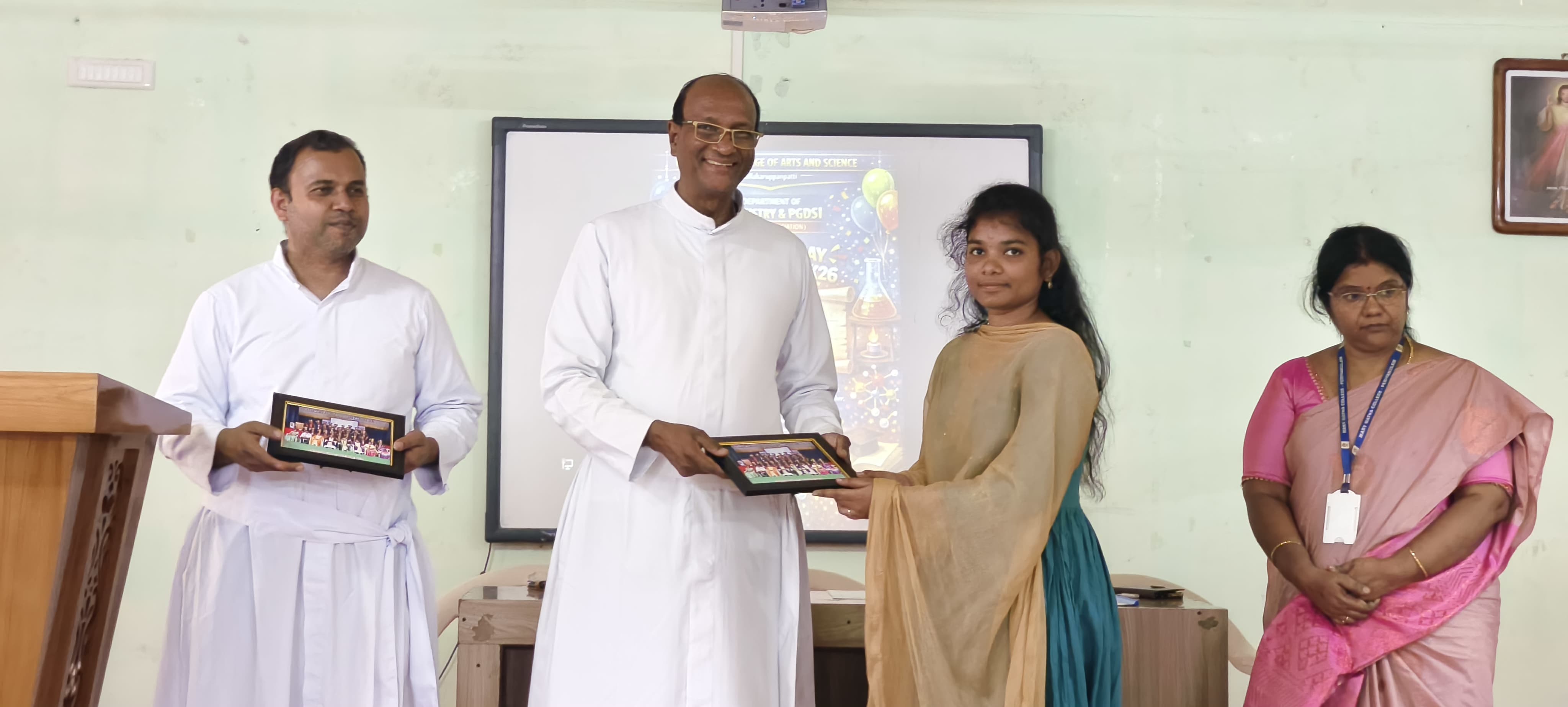
Objectives:
- To bid a fond farewell to the graduating students
- To celebrate their achievements and accomplishments
- To provide a platform for students to share their memories and experiences
- To acknowledge the support and guidance of faculty and staff
- To mark the transition from student life to professional life
- To create a sense of nostalgia and closure for the students
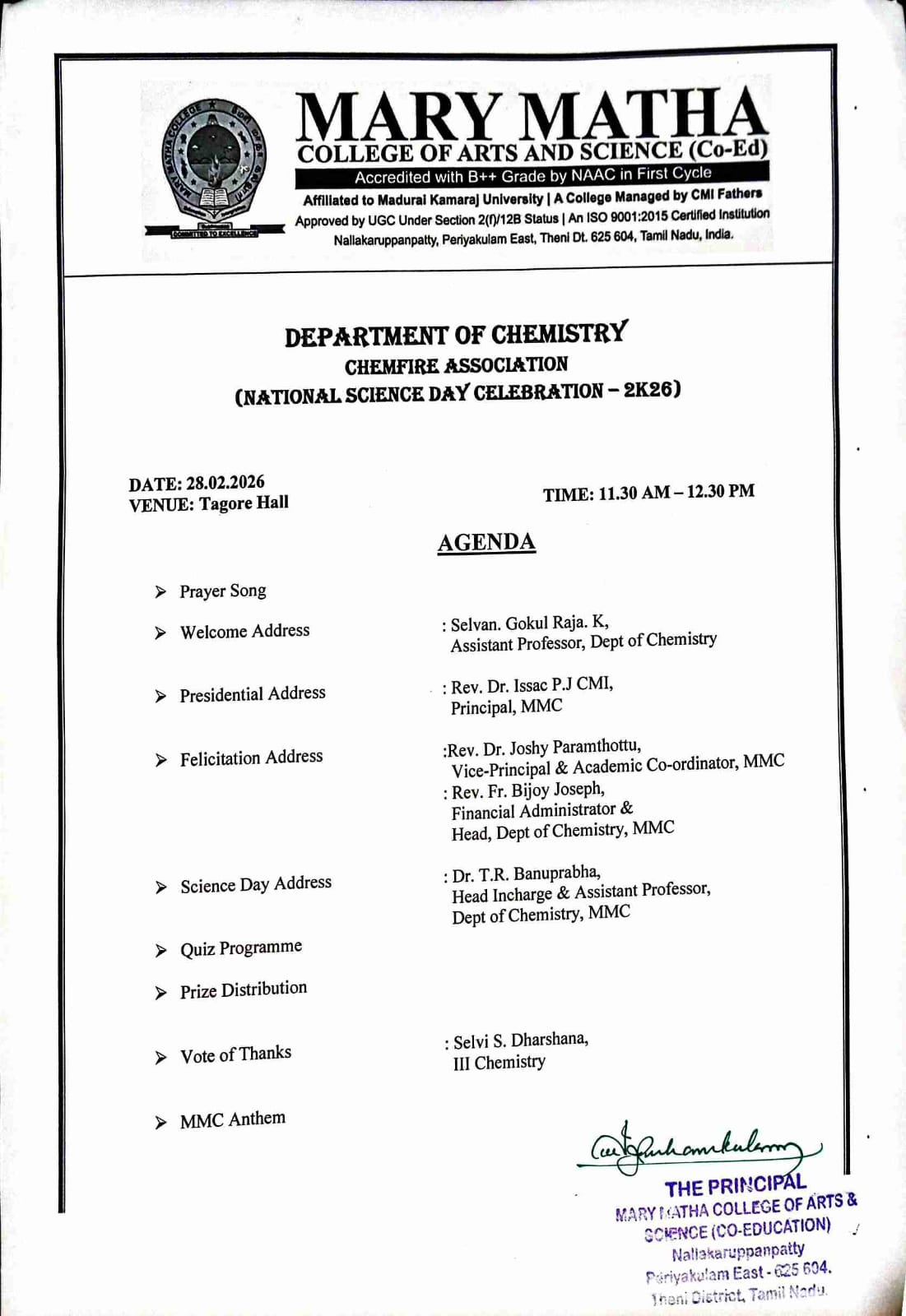
National Science Day in India is celebrated every year on National Science Day (28 February) to mark the discovery of the Raman Effect by Indian physicist C. V. Raman in 1928.
Objectives of National Science Day
- Promote scientific awareness among students and the public.
- Encourage interest in science and technology, especially among young people.
- Highlight the contributions of Indian scientists to science and society.
- Motivate students to pursue careers in science and research.
- Spread the importance of scientific thinking in everyday life.
- Provide a platform for scientific discussions, experiments, and exhibitions.
Importance of National Science Day
- Celebrates Indian scientific achievement and honors the discovery of the Raman Effect.
- Inspires students and researchers to innovate and explore new ideas.
- Promotes scientific temper, which helps people think logically and critically.
- Raises awareness about the role of science in national development.
- Shows how science improves daily life, such as in medicine, technology, agriculture, and environment.

About the Conference:
The main objective of the Conference brings together researchers, scientists and industry experts to explore the latest advancements in Advanced materials research. It fosters interdisciplinary collaboration among Scientists in Physics, Chemistry, Biology, Engineering, Mathematics, and Computer science. It addresses worldwide challenges through innovation by facilitating knowledge sharing and networking.
CALL FOR ABSTRACTS & GUIDELINES FOR PAPER SUBMISSION:
Researchers are invited to submit original and unpublished research papers presenting new findings related to the focus areas of the conference for Oral or Poster presentations. The abstract (typed in Times New Roman, font size 12, line spacing 1.5, and justified alignment) should not exceed 250 words and must include five keywords. The abstract and full paper should be emailed to mmcchemistry2016@gmail.com on or before January 9, 2026. Posters should adhere to the size 48” x 36” and can be presented in either Landscape or Portrait orientation
* Selected Papers will be published in MMC Journal of Science and Humanities, viz., MMC-JSH with ISSN 3049-4486 after review process.
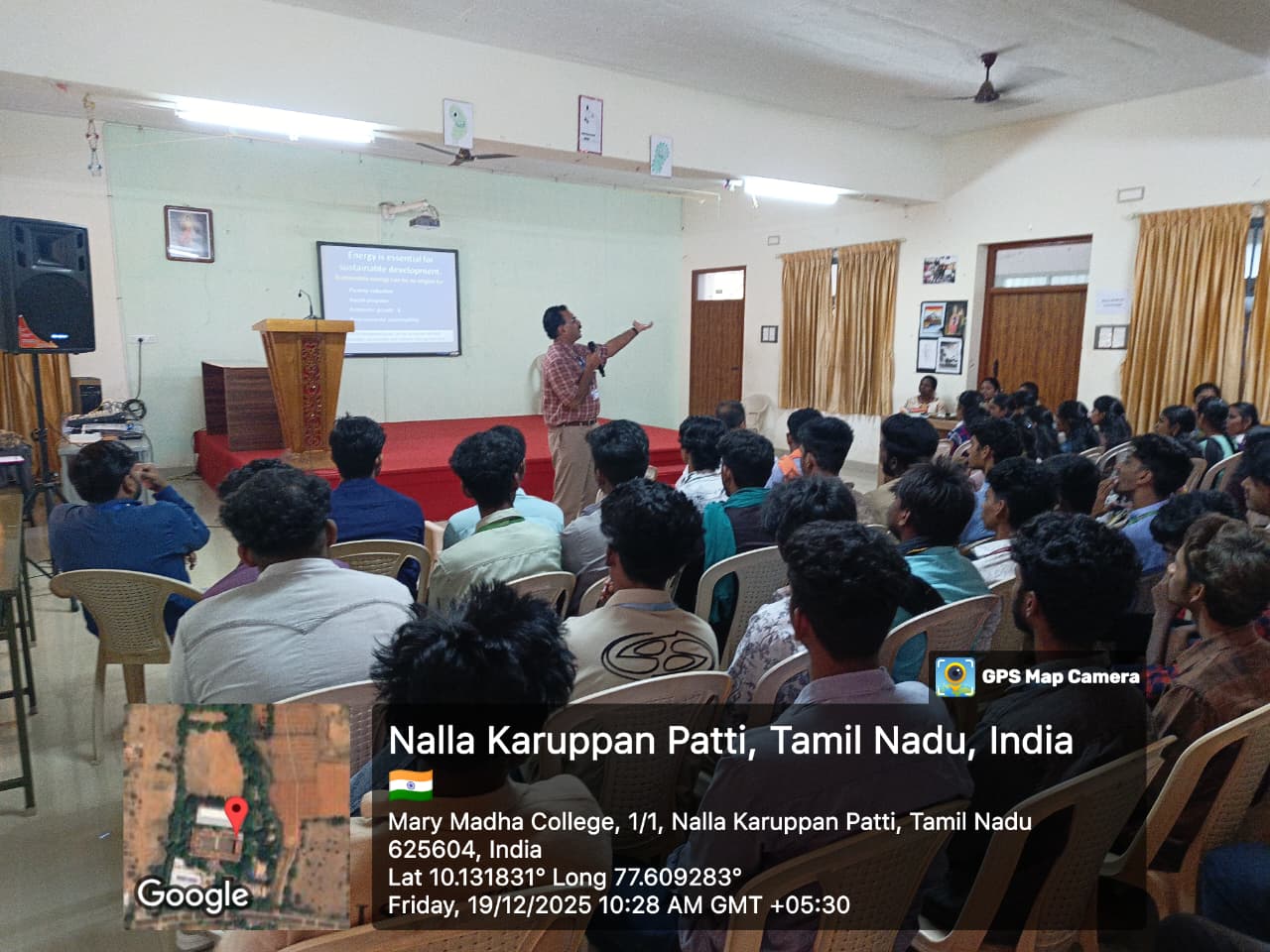
- To highlight the importance of nuclear energy as a reliable and low-carbon power source for India’s growing energy demands.
- To create awareness on India’s energy challenges and the role of nuclear power in ensuring long-term energy security.
- To explain the environmental benefits of nuclear power, including reduction of greenhouse gas emissions and support for climate-change mitigation goals.
- To promote understanding of sustainable development and how nuclear power aligns with India’s commitment to clean, affordable, and modern energy (SDG-7).
- To examine India’s nuclear power policies, infrastructure, and future expansion plans for meeting national development goals.
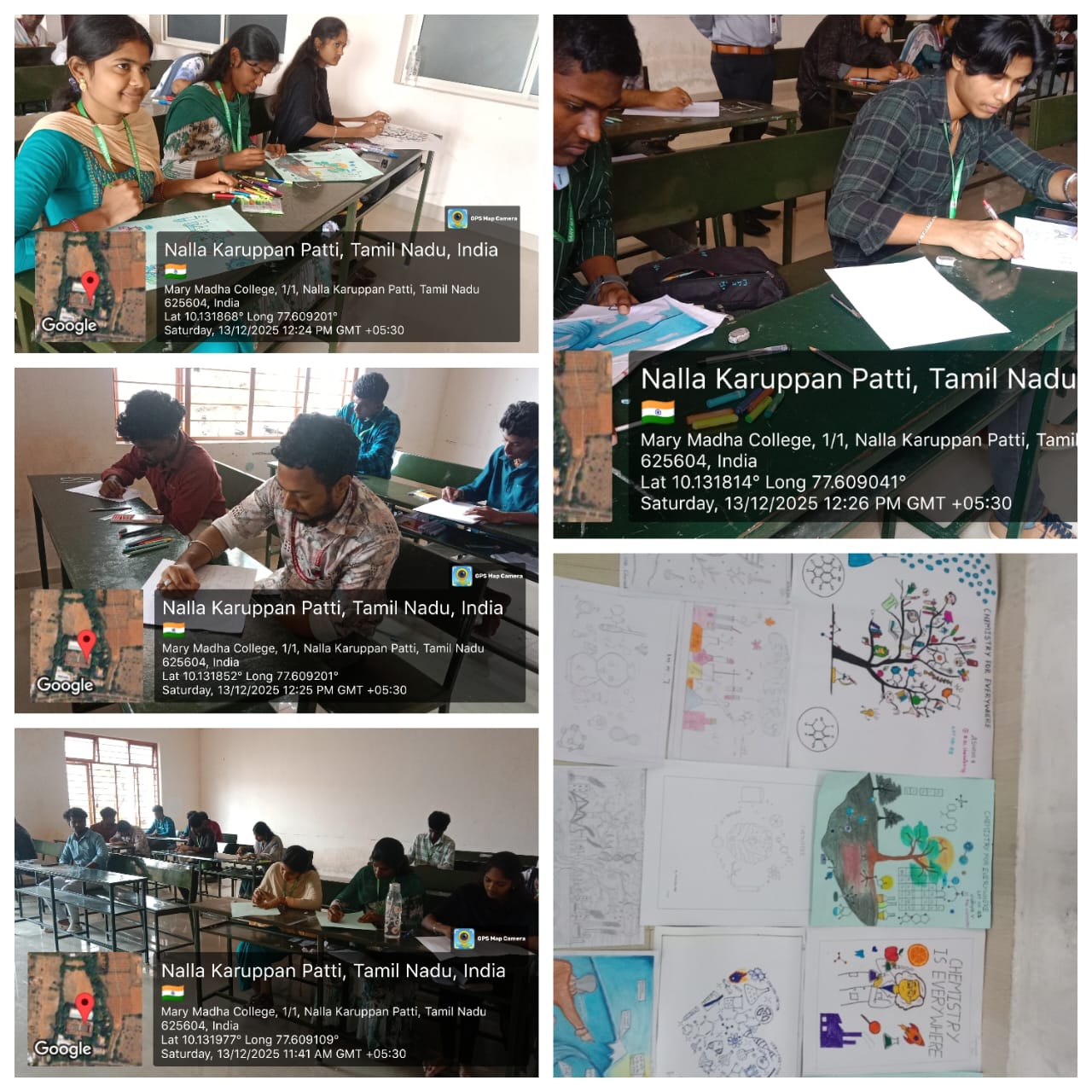
The following competitions were conducted for the students to enhance their skills in chemistry stream
1. Chem PPT
Topic: Biopolymers for sustainable materials
2. Chem Mehendi
Topic: Crystal Lattice Mehendi
3. Chem Sketch
Topic: "Chemistry is Everywhere" - Concept Art
Staff Profiles
B.Sc Chemistry
The study of science should be fascinating and enjoyable; the creation of a scientific temper in society is a must which could be achieved through proper education and guidance. To realize this goal, the curriculum should be updated by giving emphasis on various aspects such as the creativity of students, knowledge of emerging trends in the discipline, awareness of environmental impacts due to the development of science and technology, and the skills essential for handling equipments and instruments in laboratories and industries. Chemistry, being an experimental science, demands testing theories through practical laboratory experiences for a thorough understanding of the subject. The syllabus has been prepared in a participatory manner, after discussions with all stakeholders. Care has been taken to ensure that the syllabus is well-matched with the syllabi of other universities at the same level. Sufficient emphasis is given in the syllabus for training in laboratory skills and instrumentation. The units of the syllabus are well defined. A list of reference books as well as text books is provided at the end of each course.
Eligibility for admission:
Pass in Higher Secondary Examination with Chemistry, Physics and Mathematics/Zoology as core subjects or any other examination accepted by the Syndicate of Madurai Kamaraj University as Equivalent
Duration of the Course: 3 Years
Medium of Instructions: English / Tamil
Objectives of the Programme:
- To impart fundamental knowledge in the field of Chemistry
- The theory and practical aspects of the subject augment the ability of the learner to understand the implications of scientific and technical approaches involved in the domain of knowledge
- To mould the learner into a prospective skillful scientific workforce for the future
- Study of Skill based papers and Industrial visit help mutual collaboration
Outcome of the programme
A candidate after successfully completing the B.Sc degree in Chemistry becomes eligible:
- to pursue post graduate course in various branches of chemistry
- to appear in UPSC and other competitive examinations
- to get employment opportunities in chemical industries like sugar factory, paper industry, tanneries etc
- can become an entrepreneur by setting up small scale industries.
PG Diploma in Sanitary Inspector
One-year PG Diploma in Sanitary Inspector's Course is intended to provide comprehensive and intensive training that enables students to secure gainful employment, especially in government positions as Sanitary Inspectors and Health Inspectors. Additionally, they can work in non-governmental and private sectors in various departments related to water, sanitation, health, nutrition, safety, and first aid. They will act as an active link between the community and the sanitation and health care system.
Objectives
- To provide complete knowledge and skills in Biological Sciences to administer first aid and save human lives.
- To provide complete knowledge and skills in Communicable Diseases and Environmental Sanitation.
- To provide complete knowledge and skills in Public Health Administration, Special Sanitation Problems, and Public Health Acts to help them contribute effectively to society.
- To provide complete knowledge and skills in Food and Nutrition & National Health Programs to enhance their role in society.
- To record vital events and maintain reports, records, and registers.
- To use computers and sanitation/health-related software.
- To educate the community on Sanitation, Health, Nutrition, and Hygiene.
Minimum Eligibility
A pass in B.Sc. Chemistry, Food Technology, or Nutrition from a recognized university. Students from Science subjects such as Botany, Zoology, Biochemistry, Microbiology, Biotechnology, and Physics are also eligible for admission.
Age Requirement: 20-30 years
Medium of Instruction: English
Duration of the Course: One year (12 months) – Semester Pattern
Internship: 2 months
Student Projects
| # | Student Name | Project Title | View |
|---|