

Department of Computer Science
About the Department
Vision
Computer Science (CS) department envisions to empower students with a mastery of computer science fundamentals, nurturing their creativity, ethical character, and entrepreneurial spirit by maintaining international standards of excellence
Mission
Our mission is to integrate current technologies with essential soft skills, providing a wide range of computing platforms and cultivating a collaborative learning environment to prepare students for success in computer applications and related careers.
Importance of Computer Science
Computer science is at the heart of modern innovation, driving advancements in technology that transform the way we live, work, and connect. It plays a crucial role in solving complex problems, from improving healthcare through AI to enabling global communication via the internet. As the backbone of automation, cybersecurity, and data analysis, computer science empowers industries to operate efficiently and make informed decisions. Moreover, it fosters creativity and innovation, equipping individuals with the skills to shape the future in an increasingly digital world.
The department also demonstrates its uniqueness through specialized programs and outreach activities. Our Computer Literacy Program for school students, aligned with the objectives of the Digital India mission, empowers young learners with essential digital skills for a technology-driven future. Furthermore, we engage in extension activities for rural development, assisting communities in utilizing e-services like online banking, e-governance, digital transactions, and healthcare platforms, thereby promoting digital inclusivity. This integrated approach—combining academic excellence, strong industry collaboration, extensive learning resources, and impactful social initiatives—truly sets our department apart as a leader in innovation and community development. Adding to its uniqueness, the department has signed a Memorandum of Understanding (MoU) with Elysium Technologies, Madurai, enabling students to gain hands-on exposure through industry-based training, live projects, workshops, and internships. This partnership ensures our students stay updated with the latest trends and tools in the IT industry while enhancing their project development skills and employability. Additionally, the department is supported by a well-equipped library featuring a collection of reference books, journals, and practical manuals dedicated to Computer Science, which strengthens research and learning. These initiatives, along with a strong focus on innovation and practical knowledge, create an environment that truly distinguishes our department from the rest.
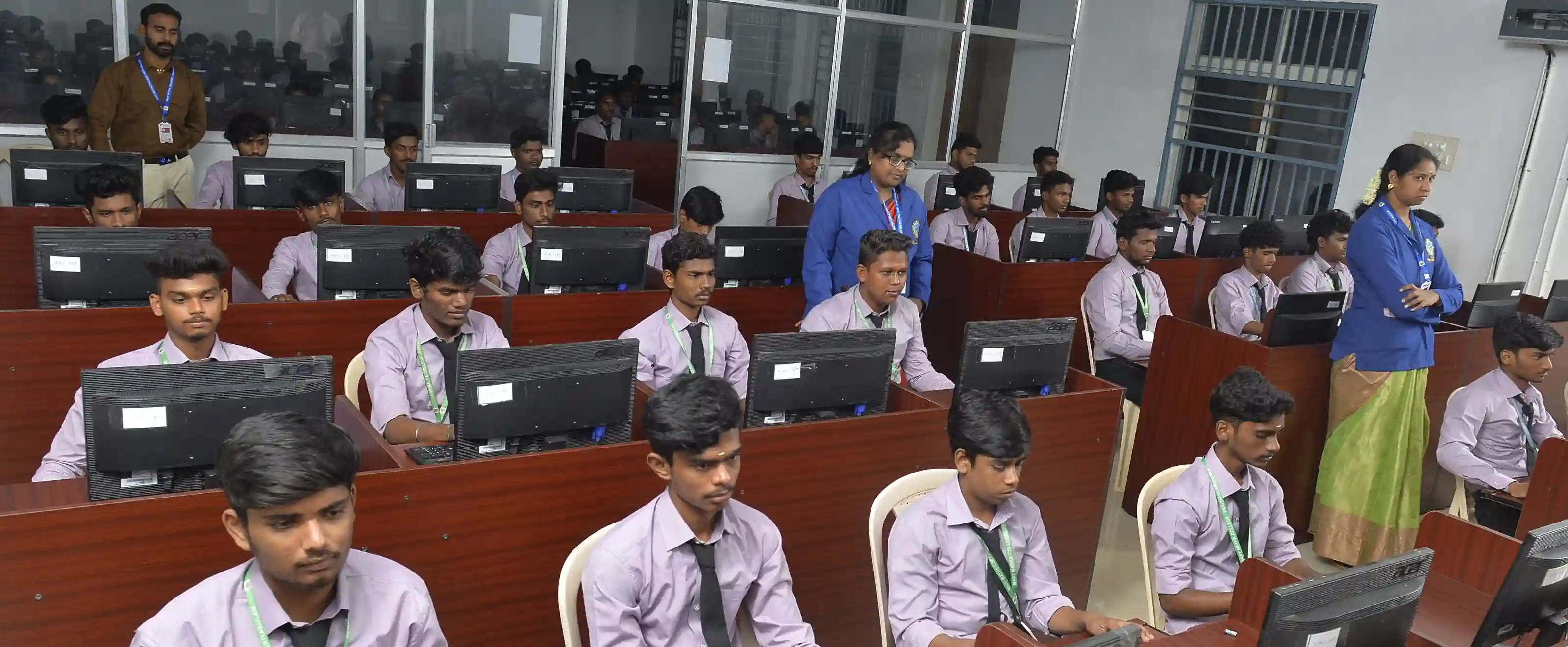
The Department of Computer Science boasts world-class infrastructure designed to foster innovation and hands-on learning. Our advanced laboratories are equipped with over 200 high-performance systems connected to the internet, ensuring an environment that supports both academic and research activities. With 24/7 Wi-Fi connectivity, students enjoy seamless access to digital resources anytime, anywhere. To enhance learning, the department provides modern multimedia software tools for creative and technical applications. Additionally, we feature specialized high-end systems dedicated to Machine Learning and Artificial Intelligence, equipped with the latest processors and updated configurations to meet the demands of cutting-edge projects. This robust and future-ready infrastructure enables students to gain practical exposure and develop the technical expertise required for thriving in the rapidly evolving IT landscape.
Staff Profiles
Other Staff Profiles
Staffs from other departments taking class for English, Part-1 Languages and other cross-major subjects.

MS. NEHA K. SEBASTIAN
Assistant Professor, Dept. of
B.Sc. Computer Science
Course Objectives:
- To prepare the students to manage the software components in a computer independently and to be a Programmer.
- To motivate the students to take up higher studies in Computer Science and other streams.
Eligibility for Admission:
A candidate should have studied +2 level Mathematics with Physics/ Computer Science as one of the subjects in the 10 +2 stream.
Duration of the Course:
The students shall undergo the prescribed course of study for a period of not less than three academic years (Six semesters).
Medium of Instruction: English
Eligibility for the Degree:
- A Candidate shall be eligible for the award of the degree on completion of the prescribed course of study and passing all the prescribed external examinations.
- Attendance progress, internal examinations, conduct certificate from the Head of the Institution shall be required for taking the external examination.
- The passing minimum and the ranking are as per the existing rule of the Choice Based Credit System for the affiliated college of the University.
B.Sc. Information Technology
Introduction of the Programme:
Information Technology prime motif focuses on databases and networking. In general IT tends to focuses on the mathematical and theoretical foundation of computing rather than emphasizing specific technologies.
Eligibility for Admission: A Candidate should have studied +2 level Mathematics in the 10 + 2 stream.
Objectives of the Programme:
- To prepare the students to manage the software components in a computer independently and to be a Programmer.To motivate the students to take up higher studies in Information Technology and other streams.'
Outcome of the Program:
- Graduates of this Program becomes a dynamic Programmer / Network Designer / System Administrator / IT Consultants / Web Designer with updated Web Development Technologies / System Engineer.
- Performs technological tasks relating the processing, storing and communication of information between computers, Mobile phones and other electronic devices.
- IT emphasizes the secure management of large amounts of variable information and its accessibility via a wide variety of systems both local and World Wide.
- Facilitates the development and application of problem solving skills in students.
Duration of the Course:
The students shall undergo the prescribed course of study for a period of not less than three academic years (Six semesters).
Medium of Instruction: English
Eligibility for the Degree:
- A Candidate shall be eligible for the award of the degree on completion of the prescribed course of study and passing all the prescribed external examinations.
- Attendance progress, internal examinations, conduct certificate from the Head of the Institution shall be required for taking the external examination.
- The passing minimum and the ranking are as per the existing rule of the Choice Based Credit System for the affiliated college of the University.
Bachelor of Computer Applications
Introduction of the Programme:
Bachelor in Computer Applications (BCA) is a three year undergraduate degree course which is divided into six semesters. Students will be taught subjects which are related to the technological applications that are required in today‟s practical work field. Students who opt for a Bachelor in Computer Applications (BCA) will get skills and information not only about Computer and Information Technology but also in communication, organization and management. One also get to learn programming languages such as Java, C++, HML, SQL, etc. Information about various computer applications and latest developments in IT and communication systems is also provided. It can land one either with a job or a startup business that we always wished or had an eye on.
Eligibility for Admission: A Candidate should have studied +2 Mathematics, with Physics/Commerce/Economics in the 10 +2 stream.
Duration of the Programme: 3 Years
Medium of instruction: English
Objective of the programme:
- Understand the fundamental concepts of Computers and IT Applications.
- Learn technologies and computer languages, so the problems could be addressed.
- Successfully understand and analyze data to come out technological solutions.
- To identify and sharpen their IT/ programming skills.
- Develop competent technical skills and ideas to communicate public.
Outcome of the Programme:
- BCA graduates will have the necessary technical, scientific as well as basic managerial and financial procedures to analyze and solve real world problems within their work domain
- Clarity on both conceptual and application oriented skills in Computers, Accounting and IT Applications.
- Awareness on ethics, values, sustainability and creativity aspects.
- The ability and the mindset to continuously update and innovate.
B.Sc. CS (Data Science and Analytics)
Computer Science is the study of quantity, structure, space, and change, focusing on problem-solving and application development. It has a wide scope in science, engineering, technology, and social sciences. Over the last few decades, Computer Science has carved out a space for itself, much like other disciplines of basic science and engineering. The field spans both theory and practice, requiring abstract and concrete thinking. Today, nearly everyone is a computer user, and many are also programmers.
Computer Science can be seen as the science of problem-solving, requiring precision, creativity, and careful reasoning. This ever-evolving discipline has strong connections to other fields, including science, engineering, healthcare, and business. Many real-world problems can be effectively solved using computers, but finding solutions requires both expertise in Computer Science and knowledge of the specific application domain.
The field of Computer Science encompasses a wide range of specialties, including Computer Architecture, Software Systems, Graphics, Artificial Intelligence, Computational Science, and Software Engineering. While all these areas draw from a common core of computer science knowledge, each specialty focuses on specific challenges. The discipline is practiced by mathematicians, scientists, and engineers. Mathematics, the foundation of Computer Science, provides reason and logic. Science offers methodologies for learning and refinement, while engineering contributes techniques for building hardware and software.
Course objectives
- To prepare the students to manage the software components in a computer independently and to be a Programmer.
- To motivate the students to take up higher studies in Computer Science and other streams.
Eligibility for Admission
A candidate should have studied +2 level Mathematics as one ofthesubjects in the 10 +2 stream.
Duration of the Course
The students shall undergo the prescribed course of study for a period of not less than three academic years (Six semesters).
Medium of Instruction: English
Eligibility for the Degree
- A Candidate shall be eligible for the award of the degree on completion of the prescribed course of study and passing all the prescribed external examinations.
- Attendance progress, internal examinations, conduct certificate from the Head of the Institution shall be required for taking the external examination.
- The passing minimum and the ranking are as per the existing rule of the Choice Based Credit System for the affiliated college of the University.
B.Sc. CS (Artificial Intelligence)
Artificial Intelligence or AI, is a branch of computer science that deals with building smart machines that are capable of performing complex tasks that normally require human interference and intelligence. It combines Data Science with real-life data to leverage machines and computers to imitate the decision-making and problem-solving capabilities that the human mind has.Many human mental activities such as writing computer programs, doing mathematics, engaging in common sense reasoning, understanding language, and even driving an automobile are said to demand intelligence. Most of the work on building such kinds of systems has taken place in the field called Artificial Intelligence (AI). This work has had an experimental and designing direction to a great
extent. Drawing from a loosely structured but growing body of computational techniques, AI systems are developed, undergo experimentation, and are improved. This interaction has created and refined a few general AI standards of wide pertinence.
The course is enabled to include several interdisciplinary areas like: Machine Learning, Deep Learning, Natural Language Processing, Robotics, Artificial Intelligence in Business and Society and The Future of Artificial Intelligence, operating systems, databases, business intelligence, big data, probability and statistics, data optimization, statistical simulation and data analysis, management decision analysis, decision models and predictive analysis. Artificial Intelligence has gained paramount importance in the computer science domain. The need for scientists who understand data in all its aspects will continue to grow strongly.Students graduating from the program will have significantly more depth and breadth in the broad area of Data Science and receive all the information they need to work with various kinds of data and statistical data. The program is designed so that students have in-depth knowledge of the many approaches, aptitudes, methodologies, and instruments needed to deal with corporate data. Students receive instruction in the abilities needed to find the needed solutions and assist in making significant judgments.
AI is a vast field in itself. Not only does it covers an extensive range of topics, but it also has a lot of depth as the AI algorithms use a lot of advanced mathematics. Thus, the eligibility for an AI course can depend on the nature of the course. However, if the course is not getting into extreme levels of depth (regarding the exact functioning of various AI algorithms), then the typical eligibility would be working knowledge of analytics tools especially Python for Data Science, while candidates from different educational backgrounds can take up artificial intelligence courses, having knowledge of mathematical concepts such as Calculus can give one a slight edge in understanding the mathematical functioning of the algorithms, Knowledge of basic Data Science is required which includes data manipulation and statistical modelling.
Course objectives
- To prepare the students to manage the software components in a computer independently and to be a Programmer.
- To motivate the students to take up higher studies in Computer Science and other streams.
Eligibility for Admission
A candidate should have studied +2 level Mathematics as one ofthesubjects in the 10 +2 stream.
Duration of the Course: The students shall undergo the prescribed course of study for a period of not less than three academic years (Six semesters).
Medium of Instruction: English.
M.Sc. Computer Science
Course Objective:
To prepare the students to manage the software components in a computer independently and to be a Programmer/Project Leader. To motivate the students to take up Academic Research in Computer Science and other streams.
Eligibility for Admission: Students who studied B.Sc.(CS) and BCA.
Duration of the Course: The students shall undergo the prescribed course of study for a period of not less than two academic years ( Four semesters).
Medium of Instruction: English
Eligibility for the Degree:
- A Candidate shall be eligible for the award of the degree on completion of the prescribed course of study and passing all the prescribed external examinations.
- Attendance progress, internal examinations, conduct certificate from the Head of the Institution shall be required for taking the external examination.
- The passing minimum and the ranking are as per the existing rule of the Choice Based Credit System for the affiliated college of the University.
B.Sc. Computer Science (Digital Forensics and Cyber Security)
The B.Sc. Digital Forensics and Cyber Security programme is an undergraduate course aimed at providing students with fundamental and practical knowledge in digital crime investigation, cyber security, and the handling of electronic evidence. The programme integrates concepts from computer science, forensic science, and law to address the growing challenges of cyber crime.
Admission Criteria
Admission to the programme is open to candidates who have completed 10+2 or its equivalent, preferably with a background in science and/or computer-related subjects, in accordance with the norms prescribed by the affiliating university and regulatory authorities.
Objectives of the programme
The programme seeks to develop technical skills in digital forensics tools and cyber security techniques, enhance understanding of cyber laws and ethical practices, and cultivate analytical thinking required for investigating cyber crimes and protecting digital systems.
Outcome of the programme
On successful completion of the programme, students will be able to identify and analyze digital evidence, understand cyber threats and security mechanisms, apply forensic methods in cyber crime investigations, and pursue employment or higher education in digital forensics, cyber security, law enforcement, and allied domains.
Student Projects
| # | Student Name | Project Title | View |
|---|---|---|---|
| 1 | R.DEEPAK
(C2S31008)
|
SMART PARKING RESISTANCE | View |
| 2 | DEVADHARSHINI M R
(C2S31753)
|
AI BASED TRAFFIC VIOLATION DETECTOR | View |
| 3 | KIRTHIKA SRI.K
(C2S31756)
|
AI WASTE SORTING ADVISOR | View |
| 4 | G. K. KALAIYARASAN, S. KARTHIKEYAN
(C2S31019, C2S31020)
|
BOOKHIVE | View |
| 5 | DRAVID KUMAR P
(C2S31762)
|
AI INVENTORY OPTIMIZER | View |